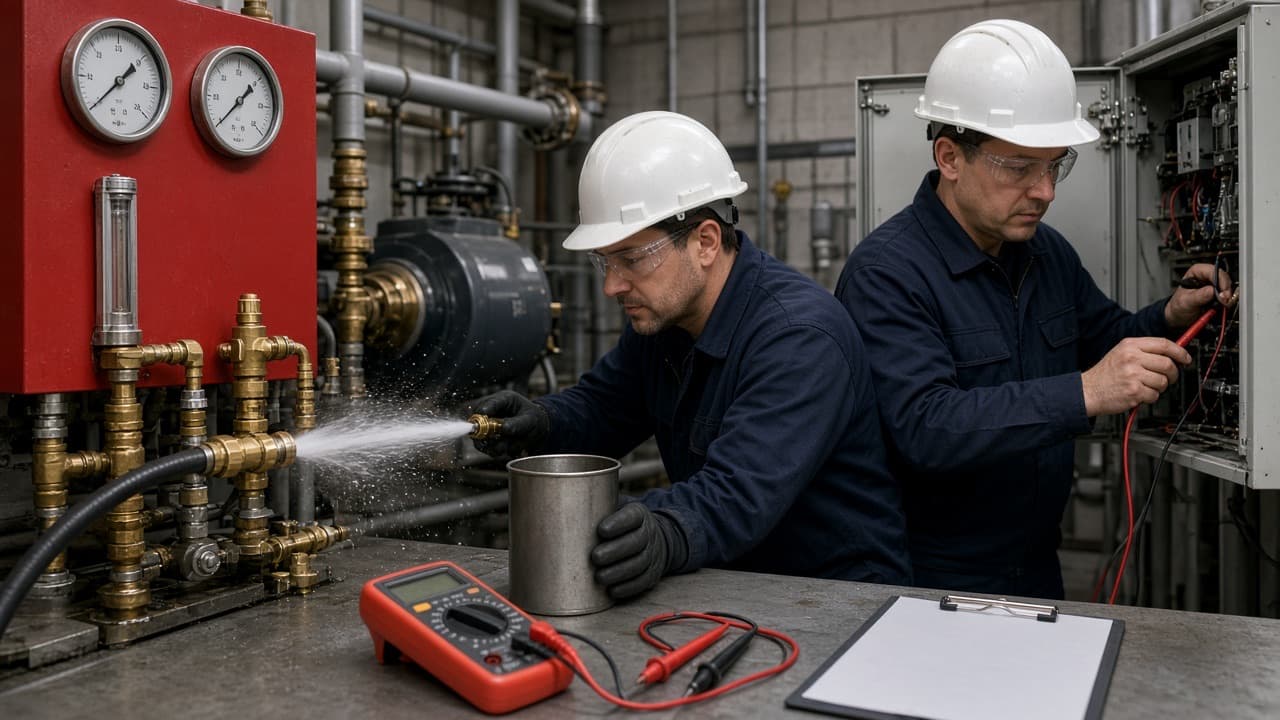
After installation, critical safety systems have to be tested under real conditions, with each scenario trigger and interaction confirmed in sequence. ALARA gives that process the status of a formal record. Every test is logged for performance, response time, conformity and the site scenario. The question is not only whether it ran, but whether it ran correctly.
Fire-scenario conformance tests
The designed scenario is confirmed against the real triggers, and the interlock, shutdown and voice-alarm stages are watched in order.
Detection, alarm and control function tests
Detectors, call points, sounders, beacons, panels and automation outputs are tested one by one on site.
Suppression function tests
Expected flow, pressure and activation are checked for sprinkler, special-hazard and gaseous systems.
Fire-pump function tests
Start sequence, pressure and uninterrupted running of the duty and standby pumps are verified.
Smoke-control function tests
Fan direction, extract capacity, damper timing and the prevention of smoke transfer between zones are checked.
Smoke-exhaust function tests
Whether the exhaust clears the correct zones, and whether the clearance time stays within the target, is confirmed.
Pressurisation function tests
The required positive pressure difference is measured in the stair, the escape corridor and the lift shaft.
Hydrant flow tests
Whether hydrant flow and pressure meet the scenario is confirmed.
Main-drain tests
Whether the branches can be drained, without blockage or backflow, is confirmed.
The witness report reduces risk before official acceptance. The tests are documented independently, and that record is used in inspection and insurance.
Request a witness testFrom clients
We worked with the ALARA team on modernising the fire-detection systems at our industrial plant. Both project management and commissioning were thoroughly professional. On-time delivery and complete technical documentation made the work much easier.
They took on fire-safety design and site inspection at our construction site. The team's command of the field and their rigour on the standards were genuinely impressive. ALARA is now a solution partner on our projects.
We asked ALARA to integrate the fire-automation systems into our BMS. The integration was uneventful, the reporting screens are easy to use, and their continued support moved the operation forward.
Questions
Which stages does your fire engineering service cover?
It covers pre-design risk analysis, system design, hydraulic calculations, material selection, installation review and commissioning inspections. The whole process follows international NFPA and EN standards.
Can fire protection systems be integrated with building automation?
Yes. ALARA specialises in this. We integrate fire systems with BMS, SCADA or PLC infrastructure so the whole building can be supervised from one centre.
How often do you provide periodic maintenance?
It depends on the site. We typically recommend a check every six months and a full test once a year, with 24/7 emergency support when required.
Do you work on projects outside Turkey?
Yes. There are 1,134 reference projects in 41 countries. Experience is 37 years in the home country and 33 years abroad, covering design, supervision, testing and commissioning, and consulting.
Who are the training and consulting services for?
We prepare dedicated programmes for our clients' technical teams, maintenance staff and occupational safety specialists. Training is planned project by project, on site or remotely.
From the practice
Sustainable Safety: Energy Efficiency and Environmental Care
Sustainability in fire protection: energy-efficient systems with a smaller environmental load.
The Role of Automation in Fire Safety
Fire automation in intelligent buildings: technology and protection in one sequence.
An Engineering Approach to Fire Protection Systems
Why sound engineering is what makes a fire-protection system save lives.